
Why Every Business Needs a Trusted IT Partner in Their Corner
Technology spending is one of the hardest investments to evaluate. A new workstation has a price tag. A software subscription has a monthly fee. A support invoice has a clear line item. But the real value of IT rarely shows up in a single report or balance sheet entry.
Instead, it appears in quieter places. It shows up when employees stop losing hours to recurring technical issues. It becomes visible when systems remain available during peak business hours. It is felt when leadership can forecast IT spending rather than scramble to absorb surprise repair costs. And it shows up in the moments when a potential security threat is neutralized before it ever interrupts operations.
That is the practical meaning of managed IT ROI. It is not just about comparing the cost of outsourced support against the cost of hiring internally. It is about understanding how managed IT affects productivity, uptime, risk, budgeting, and the overall performance of the business.
For businesses of every size, from emerging startups to established enterprises, managed IT services offer a more disciplined and strategic approach to technology. Looking beyond the monthly IT expense reveals what companies are actually gaining: better support, stronger planning, and more predictable technology management.
Managed IT ROI Begins With Control
The first return many businesses experience from managed IT is control. Not a dramatic, overnight transformation, but fewer loose ends, fewer surprises, and fewer recurring problems that drain attention from the work that drives revenue.
Without a structured IT model, businesses often operate in a cycle of reaction. A device fails. A network slows down. A user gets locked out. A server needs urgent attention. A vendor issue stalls a project. Each problem may seem manageable on its own, but together, they create hidden costs across the organization.
This is why managed IT ROI should be measured through the lens of business control. A managed service provider brings structure to support, maintenance, cybersecurity, vendor management, asset tracking, and long-term planning. The return comes from replacing uncertainty with consistency.
The ROI of IT support becomes even clearer when leaders account for the time employees spend recovering from disruptions. A fast support response matters, but the bigger value comes from preventing repeat disruptions, reducing downtime, and giving staff the confidence that technology will work when they need it most.
The Hidden Cost of Reactive IT
Reactive IT may look affordable at first. A business only pays when something breaks, which can feel lean and practical. Over time, however, that model often becomes expensive in ways that are hard to track.
Emergency fixes usually cost more than planned maintenance. Downtime interrupts work at the worst possible moment. Aging equipment stays in place until it creates a bigger problem. Security gaps go unnoticed because no one consistently reviews the environment. Software licenses continue to renew even when they are underused.
These issues quietly chip away at profitability.
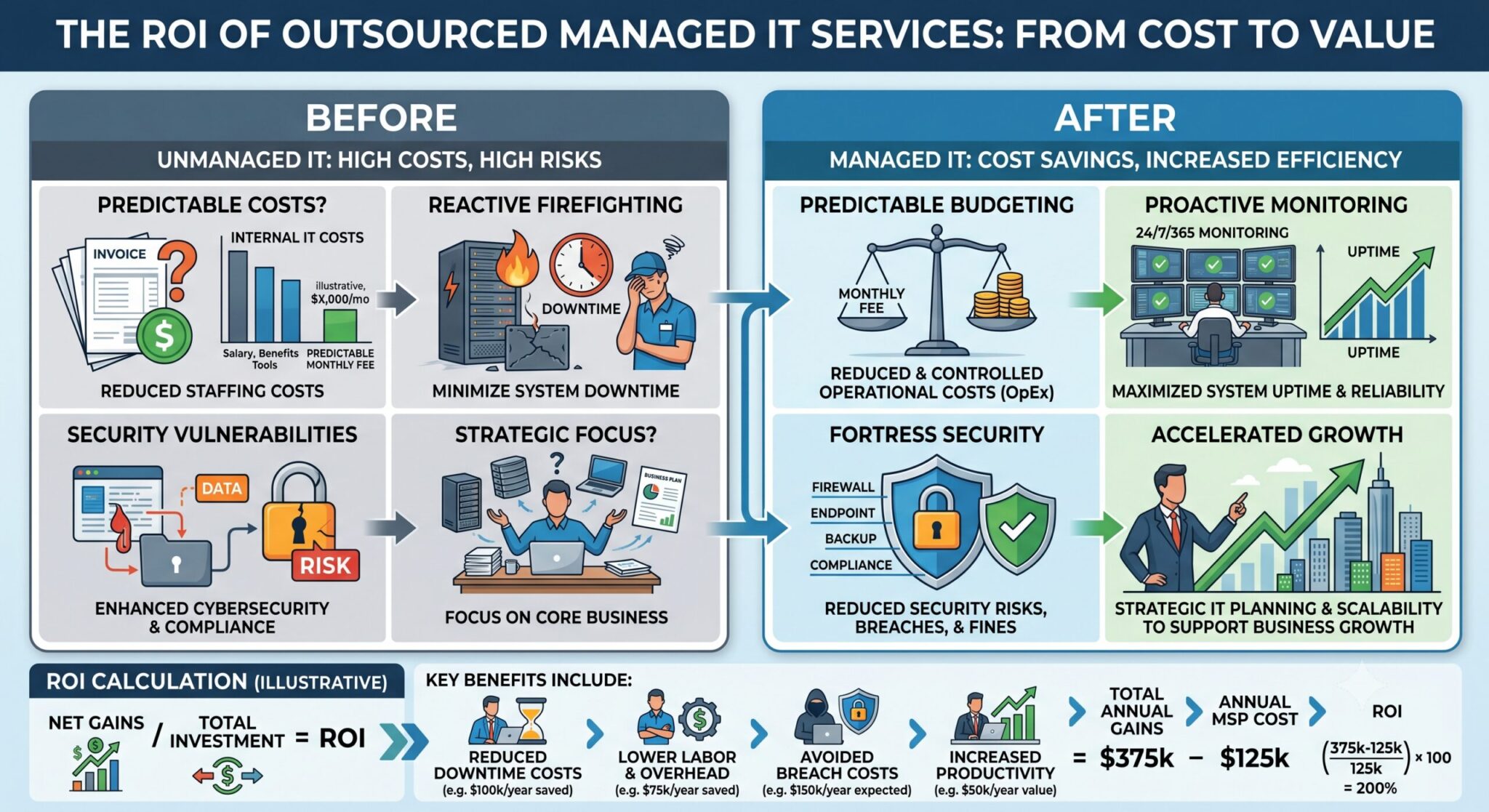
Strong IT cost savings come from reducing that waste. Instead of paying for repeated emergencies, the business invests in monitoring, maintenance, documentation, and support that keep the environment healthier. Instead of guessing when systems need attention, leaders get clearer visibility into what should be upgraded, replaced, secured, or simplified.
The savings from managed IT are not limited to a lower support bill. They also come from avoiding downtime, fewer urgent repairs, better vendor coordination, smarter licensing, and less time lost to unresolved technical problems.
When evaluating IT outsourcing options, the conversation should include both direct and indirect costs. Direct costs are easy to see. Indirect costs are the lost hours, delayed projects, missed opportunities, and operational friction that build up when IT is handled inconsistently.
Turning IT Spend Into Operational Value
Managed IT creates value by making technology easier to manage, easier to predict, and easier to align with business goals.
That starts with proactive support. Systems are monitored before small issues become large problems. Updates and patches are handled with a plan. Devices are documented. Networks are reviewed regularly. Security tools are managed continuously. Users have a clear, dependable place to go for help.
These are the everyday managed IT benefits that make a business feel more stable. Employees spend less time troubleshooting. Managers spend less time coordinating with vendors. Finance teams deal with fewer unexpected expenses. Leadership gains a clearer view of overall technology health.
Managed IT also supports better decision-making. A business may know it needs new tools, stronger security, or a better cloud setup, but without expert guidance, those decisions can become expensive guesses. With the right partner, IT planning becomes more intentional and strategic.
This is especially important as more businesses rely on cloud platforms. Managed cloud services can help improve access, scalability, and continuity, but cloud environments still require ongoing oversight. Poorly managed cloud systems can lead to unnecessary spending, security gaps, and user frustration.
A strong managed IT strategy connects support, cloud, cybersecurity, infrastructure, and planning into one coordinated approach.
The Metrics That Make IT ROI Visible
IT value is easier to understand when measured in business terms. Not every benefit can be reduced to a simple number, but the right metrics help leaders see whether technology is improving operations or quietly creating drag.
Useful IT ROI metrics may include:
- Downtime hours
- Ticket response and resolution times
- Recurring issue trends
- Emergency repair costs
- Security incidents prevented or contained
- Software utilization rates
- Device age and lifecycle
- Backup reliability
- Budget variance
These measurements help tell a larger story. Reduced downtime points to stronger continuity. Faster ticket resolution shows improved support performance. Lower emergency spending signals better planning. Better software utilization shows that the company is getting more from the tools it already pays for.
The ROI of IT support should also account for employee productivity. If staff members lose fewer hours to slow systems, password issues, application errors, or unreliable devices, the business gains time back across every department. That recovered time may not appear as a single invoice reduction, but it has very real financial value.
There is also a broader budget impact. Industry research shows that managed services can free up a significant portion of IT budgets typically tied to routine maintenance, allowing businesses to shift more resources toward growth and innovation. That shift transforms technology spending from a maintenance burden into a strategic asset.
Pricing Should Support Predictability and Performance
Price matters for every business. The goal is not to spend more on IT for the sake of it. The goal is to spend in a way that produces better outcomes and fewer surprises.
That is why managed IT pricing models should be evaluated by value, not just by monthly cost. Some providers use per-user pricing. Others charge by device, service tier, or bundled support package. Each model can work, depending on the business’s size, complexity, and needs.
The important factor is alignment.
A company with heavy compliance requirements may need more security oversight. A business with multiple locations may need stronger network management. A growing office may need dependable help desk coverage. A cloud-based team may need more robust support for productivity platforms, identity and access management, backups, and collaboration tools.
The lowest price may not deliver the strongest return if it leaves critical gaps. Strong pricing models give the business predictable costs while still covering the services that matter most.
This is where long-term IT cost savings become easier to achieve. Predictable pricing helps reduce financial surprises, while proactive support helps prevent avoidable issues. Together, they create a cleaner path toward sustainable savings.
Why Emerging Businesses Need a Trusted IT Partner
For emerging businesses and growing startups, the stakes around IT decisions can be even higher. Smaller teams often wear multiple hats, and a single unresolved technical issue can stall an entire department. Founders and early leaders rarely have time to become full-time IT managers, yet the technology choices made in those early years often shape the business for years to come.
A trusted managed IT partner helps emerging businesses build on a strong foundation from day one. That includes selecting the right tools, configuring secure environments, planning for scalability, and avoiding the costly habit of patching together systems that do not work well together.
For larger and established businesses, a managed IT partner adds a different kind of value: depth, specialization, and the ability to coordinate complex environments without overburdening internal teams. Whether supplementing an existing IT department or serving as the primary technology team, a managed partner brings discipline and continuity to operations that have grown beyond what reactive support can handle.
What a Trusted Managed IT Partner Should Deliver
A managed IT relationship should clarify technology rather than complicate it. Business leaders should understand what is being supported, where risks exist, which systems need attention, and how IT spending connects to operational goals.
A strong managed IT partner helps businesses improve reliability, support, security, cloud management, infrastructure planning, and cost control. The focus should always be practical: reducing rec


